A Guide to eIDAS Signature Levels
If you are comparing e-signature tools for European business use, a guide to eIDAS signature levels matters for one reason above all: choosing the wrong level can either create unnecessary cost or leave you with weaker evidence than your process really needs. For HR, finance, legal and operations teams, that decision affects risk, speed and day-to-day admin.
The good news is that eIDAS is not designed to make signing harder. It gives businesses a clear framework for matching the level of signature to the importance of the document, the identity risk involved and the evidential strength you may need later. Once you understand the three levels – SES, AES and QES – the decision becomes much more practical.
Guide to eIDAS signature levels: what the three levels mean
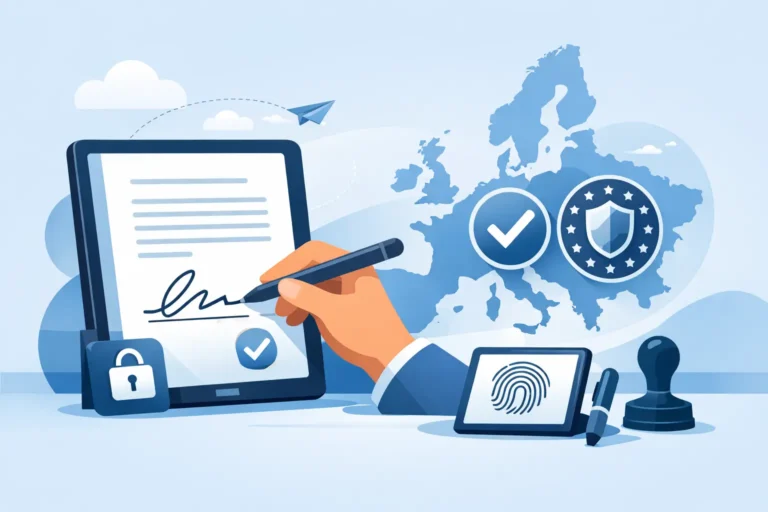
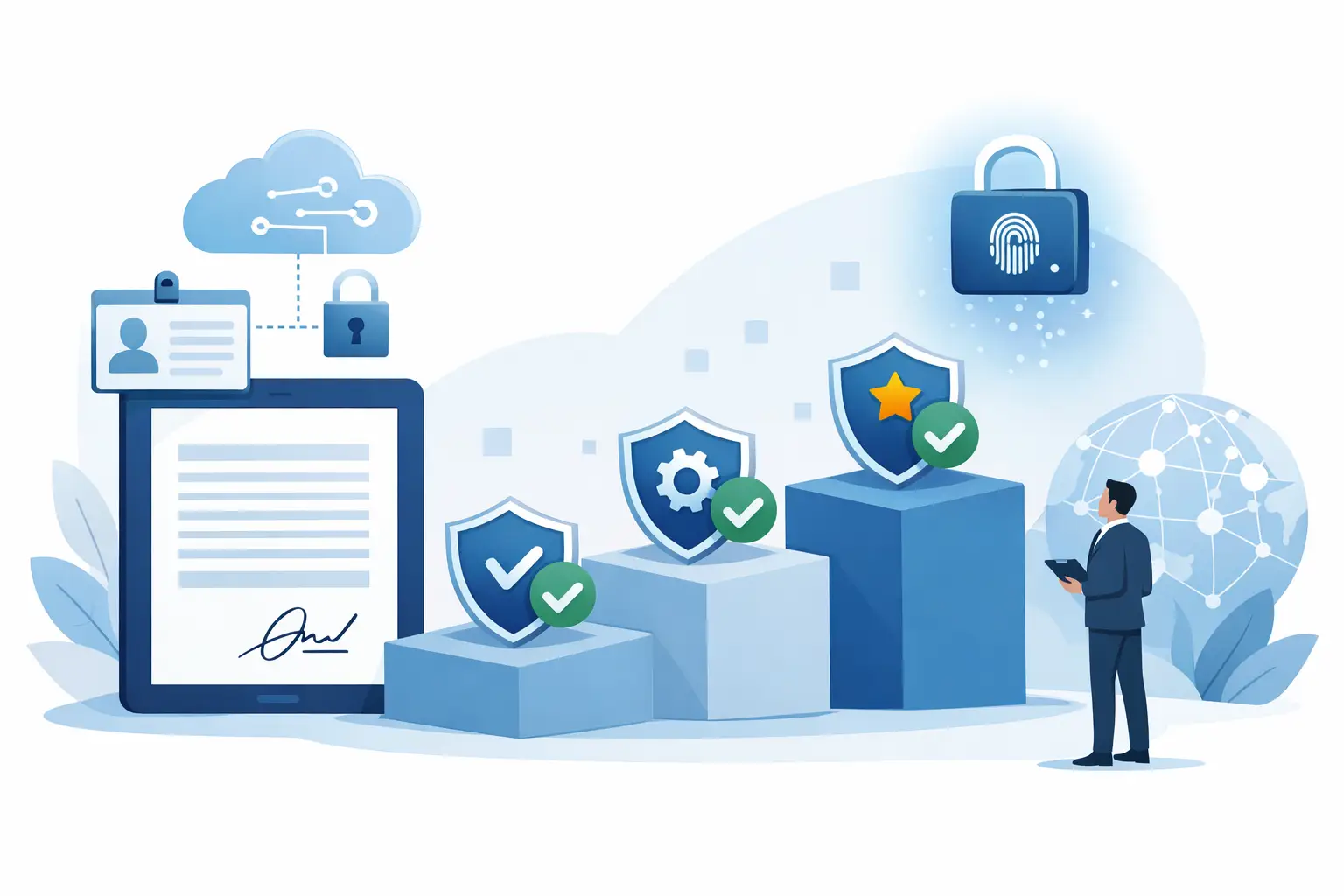
Under the eIDAS framework, electronic signatures are recognised across the EU, but not all signatures offer the same level of assurance. The three levels are Simple Electronic Signature, Advanced Electronic Signature and Qualified Electronic Signature.
A Simple Electronic Signature, or SES, is the broadest category. In practice, this can include clicking to sign, typing a name, drawing a signature or applying a basic electronic mark to approve a document. SES is quick and easy to use, which makes it suitable for lower-risk processes where convenience matters and the consequences of dispute are limited.
An Advanced Electronic Signature, or AES, adds stronger requirements. It must be uniquely linked to the signer, capable of identifying them, created using signature creation data that the signer can use under their sole control, and linked to the signed data in a way that reveals later changes. In simple terms, AES gives you stronger evidence about who signed and whether the document was altered after signature.
A Qualified Electronic Signature, or QES, is the highest level. It is a specific type of advanced signature created using a qualified signature creation device and based on a qualified certificate issued by a qualified trust service provider. Under eIDAS, a QES has the equivalent legal effect of a handwritten signature across EU member states.
That hierarchy matters, but it does not mean QES is always the best choice. The right level depends on the workflow.
Why eIDAS signature levels are not just a legal detail
For many businesses, the mistake is treating signature levels as a legal footnote to sort out later. In reality, they shape onboarding, sales contracts, supplier approvals, employment documentation and internal sign-off processes.
If your team uses a lower-assurance signature where identity certainty is central, you may create avoidable evidential gaps. If you use QES for every routine approval, you may slow down processes, increase cost and frustrate signers. Most teams need a workable middle ground, especially when documents move quickly between employees, clients, suppliers and external advisers.
This is why a practical compliance-first setup usually starts with document classification. Ask what is being signed, how serious the consequences are if challenged, whether strong identity verification is needed, and what proof you may need to rely on in court, in an audit or during a regulatory review.
When SES is usually enough
SES works well for lower-risk, higher-volume workflows where the main objective is efficiency and a clear record of acceptance. Think standard internal approvals, basic acknowledgements, routine commercial paperwork or documents where the surrounding evidence is already strong.
That surrounding evidence can matter a great deal. If you have an audit trail, email records, access logs, document history and a clear process showing who received and signed what, SES may be entirely proportionate. Legal validity does not disappear simply because a signature is simple.
The trade-off is evidential strength. If the signer later disputes that they signed, or claims the document was altered, SES may require you to rely more heavily on the broader record around the transaction. For many SMEs, that is acceptable in lower-risk cases. For more sensitive documents, it may not be.
Where AES becomes the practical default
For many professional teams, AES is the most useful balance between legal assurance and operational simplicity. It offers stronger signer linkage and tamper evidence without forcing every document into the highest-assurance route.
This is particularly relevant for growing organisations that handle recurring contracts, employment documents, approval chains and customer agreements that need more than a basic click-to-sign record. If the document has commercial importance, personal data implications or a realistic chance of later challenge, AES is often the sensible standard.
It is also where many teams start to think more seriously about platform design. You need clear signer identification, reliable audit trails, controlled workflows, secure storage and a signing process that does not create confusion. A system that supports structured sequences, status tracking and document organisation can make compliance easier because it reduces process mistakes, not just legal risk.
For European businesses that want stronger assurance without enterprise complexity, this is often the point where a platform with unlimited advanced signatures becomes commercially attractive. Paying per AES can discourage good practice by turning compliance into a usage penalty.
When QES is the right choice
QES is best reserved for cases where the highest legal assurance is justified or where local practice, sector rules or counterparties expect it. Some employment, financial, legal, public sector or regulated workflows may benefit from that higher standard. In certain scenarios, QES is not just helpful but necessary.
The key benefit is clear: QES carries the strongest legal presumption under eIDAS. If you expect scrutiny around identity, consent or enforceability, it offers the most defensible position.
The trade-off is friction. QES typically involves stronger identity verification and reliance on qualified trust services. That can add time, cost and extra steps for signers. If your process does not genuinely need that level, forcing QES into every workflow can create more operational drag than value.
How to choose the right level for each document
The simplest way to decide is to assess risk, identity needs and the likely consequences of dispute. Routine documents with low risk may suit SES. Important business agreements where you want stronger evidence often fit AES. High-stakes or specifically regulated transactions may call for QES.
You should also consider who is signing. Internal staff signing routine operational forms is different from a new external counterparty signing a commercially significant agreement. Likewise, a repeat customer with a well-documented relationship presents a different risk profile from a one-off signatory you have never dealt with before.
Jurisdiction and sector practice can also influence the answer. eIDAS provides the framework, but your legal team or adviser may still want certain document types handled at a higher assurance level based on local requirements or risk appetite. That is why the right answer is often not one signature level for the whole business, but a clear policy mapped to document categories.
What businesses should look for in an e-signature platform
A platform should do more than let someone draw a signature on screen. If you are working within eIDAS, the real value is in how the system supports evidence, control and repeatability.
Look for a clear audit trail, reliable document history, signer authentication options, support for SES, AES and QES where needed, and the ability to manage templates and approval sequences without manual workarounds. GDPR-safe handling and EU-only hosting may also matter, especially for businesses with strict data sovereignty requirements.
Ease of use should not be underestimated. Compliance only works when people actually follow the process. If sending a document takes too many steps, teams will improvise outside the approved workflow. A straightforward system with good template management and automatic field detection reduces that risk by making the compliant route the easiest one.
The common mistake: using one level for everything
Many businesses either overcorrect or undercorrect. They choose SES for every document because it is fast, or insist on QES everywhere because it feels safer. Both approaches miss the point.
A sensible e-signature policy is selective. It keeps simple processes simple, applies stronger assurance where the business case supports it, and avoids paying for complexity that adds little real protection. That is usually the best route for SMEs and professional teams that need legal certainty without heavy enterprise overhead.
If you are reviewing your own workflows, start with the documents that matter most – employment agreements, customer contracts, supplier terms, finance approvals and regulated forms. Once those are mapped to the right signature level, the rest of the process becomes much easier to standardise.
The useful test is not which signature level sounds strongest. It is which one gives your team enough certainty, enough speed and enough evidence for the documents you actually handle every week.