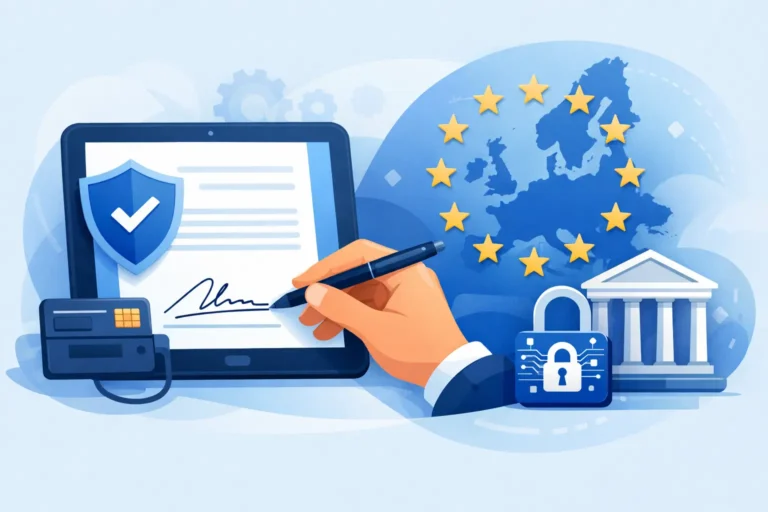

Electronic Signature Audit Trail Explained
A signed contract is only half the story. When a supplier disputes timing, an employee questions consent, or an auditor asks who approved what, the electronic signature audit trail is what turns a signed file into a defensible business record.
For small and mid-sized organisations, that matters more than many teams realise. Sending a document for signature is easy. Proving what happened, in what order, under which controls, and with what evidence is where legal certainty actually lives. If your signing process sits inside HR, finance, legal, procurement, or operations, the audit trail is not an extra feature. It is part of the evidence.
What is an electronic signature audit trail?
An electronic signature audit trail is the record of events connected to a document and its signing process. It shows what happened from preparation to completion, including actions such as document creation, sender activity, recipient access, signature placement, authentication steps, timestamps, and finalisation.
In practical terms, it answers the questions people ask when something is challenged. Who sent the document? When was it opened? Which email address received it? Was the signer authenticated? Did the document change after signature? Was there one signer or several in sequence?
A PDF with a scribbled image of a signature tells you very little. An audit trail provides context, chronology, and evidence. That is why compliance-led teams treat it as part of the signing process itself, not just a background log.
Why the audit trail matters in real business workflows
Most disputes do not begin with someone saying, “This signature is invalid.” They begin with uncertainty around process. A manager says approval was never given. A candidate says they did not receive the onboarding pack. A customer says the final version was different from the one they reviewed. Finance needs to prove who accepted payment terms before invoicing started.
This is where an electronic signature audit trail earns its place. It helps show whether the document was sent to the right party, whether that party interacted with it, whether the signing sequence was followed, and whether the final document remained intact.
For regulated or semi-regulated workflows, this is especially important. HR files, supplier agreements, engagement letters, sales contracts, internal approvals, and policy acknowledgements all create operational risk if evidence is weak. A completed signature without a reliable event history may be enough for simple internal convenience. It is not always enough when scrutiny appears later.
What should an electronic signature audit trail include?
The exact detail depends on the provider and the signature type, but a useful audit trail usually captures the full chain of activity around a document. That includes timestamps for sending, viewing, signing, and completion, along with signer identifiers such as names, email addresses, and where relevant, stronger authentication records.
It should also show document-level integrity. In other words, there needs to be evidence that the signed version has not been altered after completion. Depending on the workflow, it may record IP address data, device or browser information, consent actions, reminder activity, and the order in which multiple signers completed their steps.
For higher-assurance processes, the audit trail may also connect to advanced or qualified signature evidence, certificates, identity checks, or trust service components. That is where the difference between simple signature collection and a compliance-ready workflow becomes much clearer.
Audit trail quality matters more than having a log
Not every audit trail carries the same evidential value. Some tools generate a basic activity summary that is helpful operationally but thin from a legal or compliance perspective. Others record a far stronger evidentiary package with clear timestamps, tamper evidence, authentication history, signer intent, and document integrity controls.
That distinction matters. If your business is signing low-risk internal forms, a lighter trail may be enough. If you are handling employment contracts, recurring client agreements, regulated approvals, or cross-border EU business documents, the standard should be higher.
A useful rule is this: the more important the document, the less you should rely on a bare signature image or an inbox trail to reconstruct events later. If evidence would matter in an internal investigation, audit review, or legal disagreement, choose a process that was built to preserve it from the start.
Electronic signature audit trail and eIDAS
For European businesses, legal validity is not just about convenience or platform design. It sits within a legal framework. Under eIDAS, electronic signatures can carry different levels of assurance, including SES, AES, and QES. The audit trail supports that framework by documenting how the signing event happened and what controls were in place.
This does not mean every document requires the highest level of signature. It depends on the document type, risk profile, jurisdictional expectations, and internal policy. But in every case, the audit trail helps demonstrate process integrity. It becomes part of the evidence behind signer intent, attribution, and document integrity.
For organisations operating across EU member states, this is particularly useful. Teams often need a signing process that is simple enough for day-to-day use but still structured enough to support legal confidence across borders. A clear audit trail helps bridge that gap.
Common mistakes teams make
One common mistake is assuming that a completed PDF is self-explanatory. It rarely is. Without event data, you may struggle to prove whether the signer received the document directly, whether they completed the right version, or whether any authentication took place.
Another mistake is using inconsistent processes. If one department uses a proper signing workflow while another relies on attachments and manual confirmations, your evidentiary standard changes from document to document. That creates risk and confusion, especially when records need to be reviewed months later.
A third issue is poor retention. An audit trail only helps if it remains attached to the signed record and can be retrieved when needed. If teams export files manually, rename them inconsistently, or store them across disconnected systems, the evidence becomes harder to use.
How to assess an audit trail before choosing a platform
Start with the documents that matter most. Look at where disputes, approval bottlenecks, or compliance questions are most likely to arise. That might be HR onboarding, sales agreements, procurement, finance approvals, or customer terms.
Then ask practical questions. Does the system record a clear timeline of events? Can it show signer identities and authentication steps? Is document integrity protected after signing? Can you retrieve the audit trail easily alongside the signed file? Does the workflow support signing order, team visibility, and status tracking without extra manual work?
For many growing organisations, usability matters almost as much as compliance depth. If a platform is too complex, teams work around it. The better option is usually one that gives you legally meaningful evidence without enterprise overhead. That is the balance many European businesses are trying to strike.
Audit trails are operational tools, not just legal safeguards
It is easy to frame the audit trail as something you only need when a dispute arises. In practice, it improves everyday work as well. Teams can see where a document is stuck, which signer has acted, whether reminders were triggered, and when the process was completed.
That visibility reduces chasing, guesswork, and email back-and-forth. It also helps with internal accountability. When approvals, contracts, or acknowledgements move through a structured system with a visible history, teams spend less time reconstructing events manually.
This is one reason compliance-led features often become productivity gains in daily use. A good audit trail supports both governance and speed, provided the workflow is clear enough for people to use consistently.
When stronger evidence is worth paying for
Not every document needs maximum assurance, and pretending otherwise usually leads to unnecessary cost and friction. But some workflows do justify stronger controls, especially where identity, legal enforceability, or regulatory scrutiny is more sensitive.
If you are dealing with employment documentation, high-value contracts, regulated client onboarding, or documents where signer identity could later be disputed, stronger signature methods and a richer audit trail are often the sensible choice. For lower-risk documents, a simpler setup may be perfectly adequate.
The key is alignment. Signature type, authentication method, audit trail detail, and retention approach should match the business risk of the document. That is a more practical standard than trying to apply one level of assurance to everything.
For businesses that want that balance without unnecessary complexity, platforms such as Asignu are designed around a straightforward principle: make compliant signing easier to run, easier to evidence, and easier to manage at scale.
An electronic signature audit trail is not there to impress auditors with technical detail. It is there so your business can show, calmly and clearly, what happened when it matters most.