
Which Documents Need Qualified Signatures?
A sales contract, an HR letter and a board approval might all be signed electronically, but they do not carry the same legal risk. That is usually where the real question starts – not whether e-signatures are valid, but which documents need qualified signatures and which can be handled with a lower assurance level.
For most businesses in the EU, the answer is narrower than people expect. A qualified electronic signature, or QES, is the highest assurance level under eIDAS. It is designed for cases where the law requires a particularly strong form of signature, or where the parties want the strongest possible evidential position. But not every important document needs one. In many day-to-day workflows, an advanced electronic signature, or AES, is entirely appropriate and much easier to deploy at scale.
Which documents need qualified signatures under eIDAS?
The starting point is simple. Under eIDAS, electronic signatures cannot be denied legal effect purely because they are electronic. That means a standard or advanced signature may still be valid for many business documents. A QES matters when the law, regulation or risk profile pushes you towards the highest level of assurance.
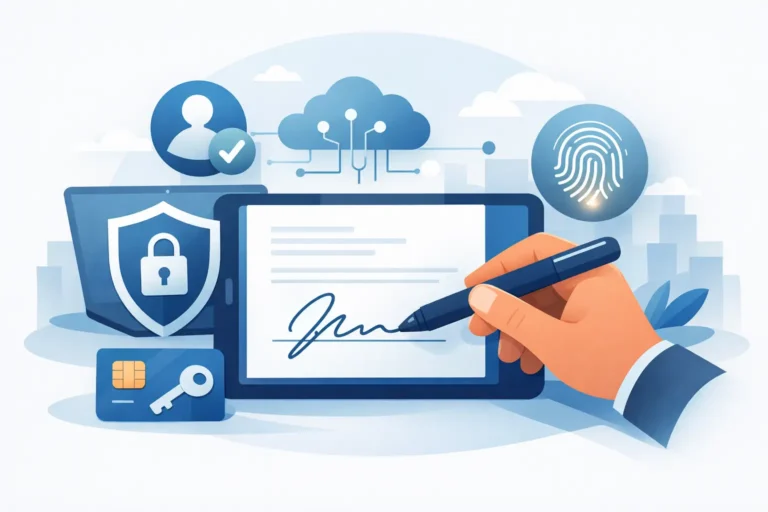
A qualified electronic signature is created using a qualified signature creation device and backed by a qualified certificate issued by a qualified trust service provider. In practical terms, that means stronger identity checks, tighter certificate controls and a legal status that is equivalent to a handwritten signature across all EU member states.
That legal equivalence is important, but it does not mean every document should automatically use QES. It means that where handwritten form matters, QES is the electronic option most likely to satisfy that requirement.
The documents that often require QES
The exact position depends on national law, sector rules and the type of transaction. There is no single universal list that applies in every scenario across Europe. Still, some categories regularly call for qualified signatures or deserve serious consideration.
Employment and HR documents in regulated cases
Many HR documents can be signed with AES or even simpler methods, depending on local law and internal policy. But where a document must satisfy a statutory written form requirement, a QES may be necessary.
This can come up with employment termination notices in some jurisdictions, certain long-term employment amendments, or documents where labour law is interpreted strictly on form. Businesses operating across borders should be especially careful here. What works for a routine onboarding form may not work for a dismissal notice.
Corporate and governance documents
Board resolutions, shareholder decisions and company filings do not all sit in the same category. Internal approvals may be fine with AES if local company law allows it and your audit trail is strong. By contrast, filings submitted to public authorities or registry procedures may require a qualified certificate or signature format recognised by that authority.
The practical point is that governance documents split into two groups: internal evidence and formal registration. The second group is where QES becomes much more likely.
Finance, lending and high-value commitments
Commercial agreements, supplier contracts and standard sales terms often do not legally require QES. However, once you move into lending, guarantees, regulated financial products or documents with substantial liability, stronger authentication becomes more attractive.
Sometimes the driver is not a strict legal requirement but risk management. If a dispute would be expensive, or identity fraud would have serious consequences, QES can be the sensible choice even where AES would probably be valid.
Real estate and notarial matters
Property transactions are one of the clearest examples of where businesses should not make assumptions. Some related documents may be handled electronically, while others involve notarisation, land registration formalities or specific national rules that go beyond ordinary e-signature requirements.
In those cases, QES may be necessary, but it still may not be enough on its own. A notary, land registry or public body may impose additional process requirements.
Public sector and regulated submissions
When documents are sent to tax authorities, regulators, procurement portals or other official systems, the receiving authority often sets the standard. In some cases, the platform itself requires a qualified certificate or a specific qualified signing method.
This is common where authenticity, identity and non-repudiation must be demonstrated to a high level. If you are dealing with a formal submission rather than a private agreement, check the receiving authority first.
Which documents usually do not need qualified signatures?
This is where many organisations can simplify their workflows. A large share of everyday business paperwork does not need QES.
Sales agreements, service contracts, NDAs, purchase approvals, standard onboarding packs, policy acknowledgements, internal authorisations and many supplier documents can often be signed using AES, provided the process is well structured. That means clear signer identification, a reliable audit trail, document integrity and evidence of consent.
For growing teams, this matters because using QES everywhere creates friction. Identity verification takes longer, user experience becomes heavier and costs tend to rise. If your legal basis and risk profile support AES, there is little value in forcing a qualified workflow onto every document.
How to decide whether a document needs QES
The best approach is operational, not theoretical. Ask four questions.
First, does local law require written form in a way that only a handwritten or legally equivalent signature will satisfy? If yes, QES should be your default assumption until legal review says otherwise.
Second, is the document being filed with a public authority, court, registry or regulated platform that specifies the signature type? If yes, follow that rule rather than your internal preference.
Third, what is the downside if the signature is challenged? A dispute over a low-value internal approval is not the same as a dispute over a director guarantee or a termination notice.
Fourth, are you signing in one country or across several EU markets? Cross-border workflows often benefit from the legal certainty of QES, particularly when formality requirements differ between jurisdictions.
These questions usually narrow the decision quickly. Most documents fall into either routine business paperwork, where AES is enough, or high-formality documents, where QES should be considered early.
Why businesses overuse or underuse QES
Some organisations assume the highest signature level is always safest. On paper, that sounds sensible. In practice, it can slow down document turnaround, frustrate signers and add unnecessary cost to everyday processes.
Others take the opposite approach and use basic signing methods for everything because they are easy. That creates avoidable legal uncertainty, especially in HR, regulated finance and public sector interactions.
The stronger position is to match the signature type to the document. Use QES where form, legal effect or evidential risk justifies it. Use AES for the broader volume of business documents where legal validity and operational efficiency both matter.
Building a practical signing policy
If your team regularly asks which documents need qualified signatures, you probably need an internal signing matrix. It does not need to be complicated. Group documents by risk and by legal formalities.
Your low-risk category might include standard commercial contracts and internal approvals, where AES is the normal route. Your medium-risk category might involve documents that need stronger identity checks or more formal audit evidence. Your high-risk category would include statutory written form documents, regulated submissions and any process where local counsel has advised QES.
This kind of policy gives operations, HR, finance and legal teams a shared rulebook. It also prevents the common bottleneck where every unusual document has to be escalated from scratch.
For document-heavy teams, the tooling matters as much as the policy. A platform should let you use simpler signature flows for routine documents, while still supporting QES when the use case demands it. That flexibility is often more valuable than a one-size-fits-all setup. Asignu is built around that practical split, so teams can keep everyday signing straightforward without losing access to higher-assurance workflows when they are genuinely needed.
The question is rarely just legal
When businesses ask which documents need qualified signatures, they are often really asking something broader: where do we need certainty, and where do we need speed?
That is the right question. Legal validity matters, but so does the reality of getting documents signed on time, by the right people, with evidence you can rely on later. A qualified signature is the right answer for some documents, but not for all of them. The better your classification and workflow design, the less often you will have to choose between compliance and efficiency.
If you are unsure about a specific document type, treat that uncertainty as a signal. Check the governing law, check the receiving authority, and decide based on risk rather than habit. That usually leads to a cleaner process and fewer problems when the signature actually has to stand up to scrutiny.