A Practical Guide to Electronic Signature Compliance
If your team is still asking whether a signed PDF is “good enough”, you do not have a signing problem – you have a compliance problem. A proper guide to electronic signature compliance starts there, because legality is only one part of the picture. The real question is whether your signing process will stand up to scrutiny when a contract is challenged, an auditor asks questions, or a regulator wants proof.
For small and mid-sized businesses, this is where confusion tends to creep in. Many platforms promise legally binding signatures, but that phrase on its own tells you very little. Compliance depends on what you are signing, who is signing it, where your business operates, and what evidence you can produce afterwards. In the European market, the framework that matters most is eIDAS, and understanding it is the difference between a convenient signing tool and a defensible business process.
What electronic signature compliance really means
Electronic signature compliance is not a single box to tick. It is the combination of legal validity, identity assurance, document integrity, recordkeeping and data protection. If one of those elements is weak, the process may still function operationally, but it becomes harder to defend when something goes wrong.
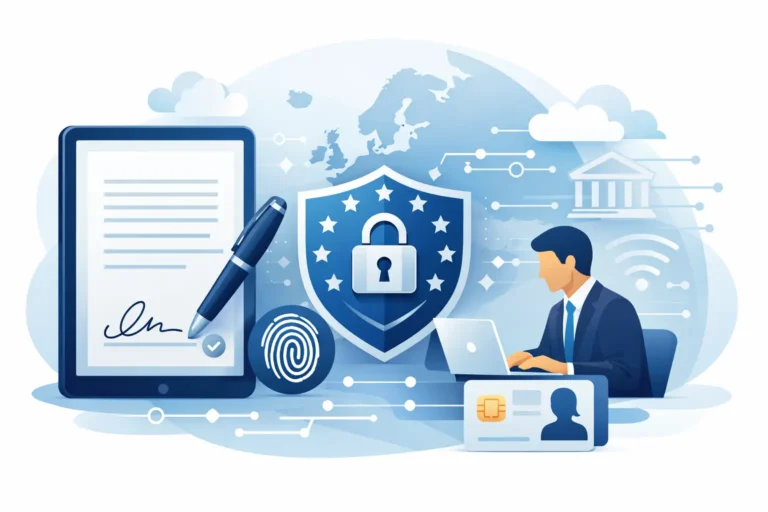
For most European businesses, compliance usually sits across two layers. The first is eIDAS, which governs electronic identification and trust services across the EU and gives legal recognition to electronic signatures. The second is GDPR, which affects how signer data, documents, audit evidence and identity information are stored and processed.
That is why a simple “click to sign” workflow is not automatically compliant in every case. It may be perfectly suitable for a low-risk internal approval, but unsuitable for an employment contract, a regulated supplier agreement or a document where signer identity could later be disputed.
A guide to electronic signature compliance under eIDAS
Under eIDAS, not all electronic signatures carry the same evidential weight. This is one of the most important points for buyers to understand.
A Simple Electronic Signature, or SES, is the broadest category. It can include ticking a box, typing a name, or drawing a signature on screen. SES can be legally valid, but it offers the lowest level of assurance. It is often enough for routine, low-risk documents where the chance of dispute is limited.
An Advanced Electronic Signature, or AES, provides stronger protection. It must be uniquely linked to the signer, capable of identifying them, created using signature creation data under the signer’s control, and linked to the signed data so that any later changes can be detected. For many business processes, AES strikes the right balance between usability and stronger evidence.
A Qualified Electronic Signature, or QES, is the highest level. It is created using a qualified signature creation device and based on a qualified certificate issued by a qualified trust service provider. Under eIDAS, a QES has the equivalent legal effect of a handwritten signature across all EU member states.
The practical point is this: compliance is not about always choosing the highest level. It is about choosing the right level for the document and the risk. Using QES for every file can add friction and cost. Using SES for everything can leave gaps in important workflows.
How to decide which signature level you need
The right approach is to match the signature method to the document type, the business risk and the consequences of a dispute.
If you are sending routine commercial agreements, internal approvals, standard sales documents or low-risk acknowledgements, SES may be acceptable. If you are handling supplier contracts, HR documents, recurring client agreements or approvals that may need stronger proof later, AES is often the more sensible option.
QES becomes more relevant where local law, sector rules or internal policy demand higher assurance. That can apply to specific employment documents, regulated financial processes, formal declarations, or cases where strong identity verification is essential.
This is also where country-specific interpretation matters. While eIDAS applies across the EU, some document categories may still be shaped by national legal requirements or industry expectations. If your business operates in multiple member states, a one-size-fits-all policy is rarely the best answer.
The compliance controls businesses often overlook
Most compliance failures do not happen because a company chose the wrong acronym. They happen because the surrounding process is weak.
Identity evidence is a good example. If a signer later denies signing, what can you show? An email address alone may not be enough for higher-risk transactions. Depending on the workflow, stronger evidence could include authentication steps, verified contact details, identity checks or a qualified certificate.
Document integrity matters just as much. You need evidence that the signed document has not been altered after signing. That is one reason secure audit trails and tamper-evident records matter so much. If your platform cannot clearly show when the document was sent, viewed, signed and completed, you are relying on trust rather than proof.
Retention is another weak spot. Signing a compliant document is only half the job. You also need to store the signed file and its evidence properly, keep access controlled, and make retrieval easy when legal, finance or HR teams need it months later.
Where GDPR fits into electronic signature compliance
Any guide to electronic signature compliance for European businesses needs to treat GDPR as part of the same discussion, not a separate admin issue. Signature workflows usually involve personal data, and sometimes sensitive data. That includes names, email addresses, IP data, identity records, job details and the contents of the documents themselves.
The key questions are practical. Where is the data hosted? Who can access it? How long is it kept? Is there a lawful basis for processing? Are processors and subprocessors clearly defined? If identity verification is used, what data is collected and how is it protected?
For many teams, data sovereignty is not theoretical. If you work in legal, HR, finance or other document-heavy functions, your signing platform becomes part of your compliance stack. EU-only hosting, controlled access and clear data handling policies can reduce both legal uncertainty and procurement friction.
What a compliant signing workflow should look like
A compliant workflow should be simple to use but precise in how it handles evidence. The best processes do not feel heavy for the sender, yet still produce a clear, defensible record.
That usually means starting with document preparation. Templates help reduce manual mistakes and ensure the right clauses, fields and signer roles are used every time. Signing sequences matter too, especially when approvals depend on order or authority.
During signature collection, each signer should receive a clear request, complete only the fields relevant to them, and be authenticated at the level the workflow requires. Once signed, the final document should be locked, time-stamped where relevant, and stored with a full audit trail.
Status tracking also has compliance value. Knowing whether a document is sent, opened, pending or completed is not just operationally useful. It helps create a record of what happened and when.
This is why many growing businesses move away from generic file-sharing or basic PDF tools. They need structure, traceability and a system that keeps pace as signing volumes increase.
Common mistakes that create avoidable risk
One common mistake is treating all documents as equal. They are not. A sales quote and a board approval should not necessarily use the same process.
Another is assuming legal validity equals evidential strength. A signature may be valid in principle but still weak in practice if identity checks, audit logs or tamper evidence are missing.
A third is buying for features before buying for fit. Many teams end up with enterprise software that is expensive, awkward to deploy and full of options they will never use. Compliance should be strong, but the workflow still needs to work for everyday teams. No enterprise complexity is a sensible requirement, not a shortcut.
It is also easy to underestimate repeatability. If every department sends documents differently, your compliance position depends too much on individual habits. Standard templates, role-based permissions and consistent signing rules make the process easier to defend and easier to scale.
Choosing a platform with compliance in mind
When assessing providers, ask practical questions rather than broad marketing ones. Which signature types are supported? How is signer identity handled? Is there an audit trail? Where is data hosted? Can the system support structured workflows, recurring templates and team controls without adding unnecessary friction?
For many SMEs and professional teams, the strongest option is not the most complicated one. It is the platform that gives you the right level of assurance for each use case, clear evidence, strong data handling and a workflow your team will actually follow. That is why European platforms such as Asignu are attractive to businesses that want eIDAS-aligned signing, GDPR-aware data handling and stronger signature options without heavyweight enterprise software.
Compliance works best when it is built into the process rather than added afterwards. If your signing workflow makes the right action the easy action, your team will move faster and your evidence will be stronger when it counts. That is usually the difference between a tool that merely sends documents and one that gives your business real control.