AES vs QES for Contracts: Which One Fits?
A supplier agreement is ready to send. The commercial terms are agreed, the approver is waiting, and the question becomes practical: AES vs QES for contracts – which level of signature is actually needed? Choosing the higher-assurance option by default can add cost and friction. Choosing too little assurance can leave your team with weaker evidence when a contract is challenged.
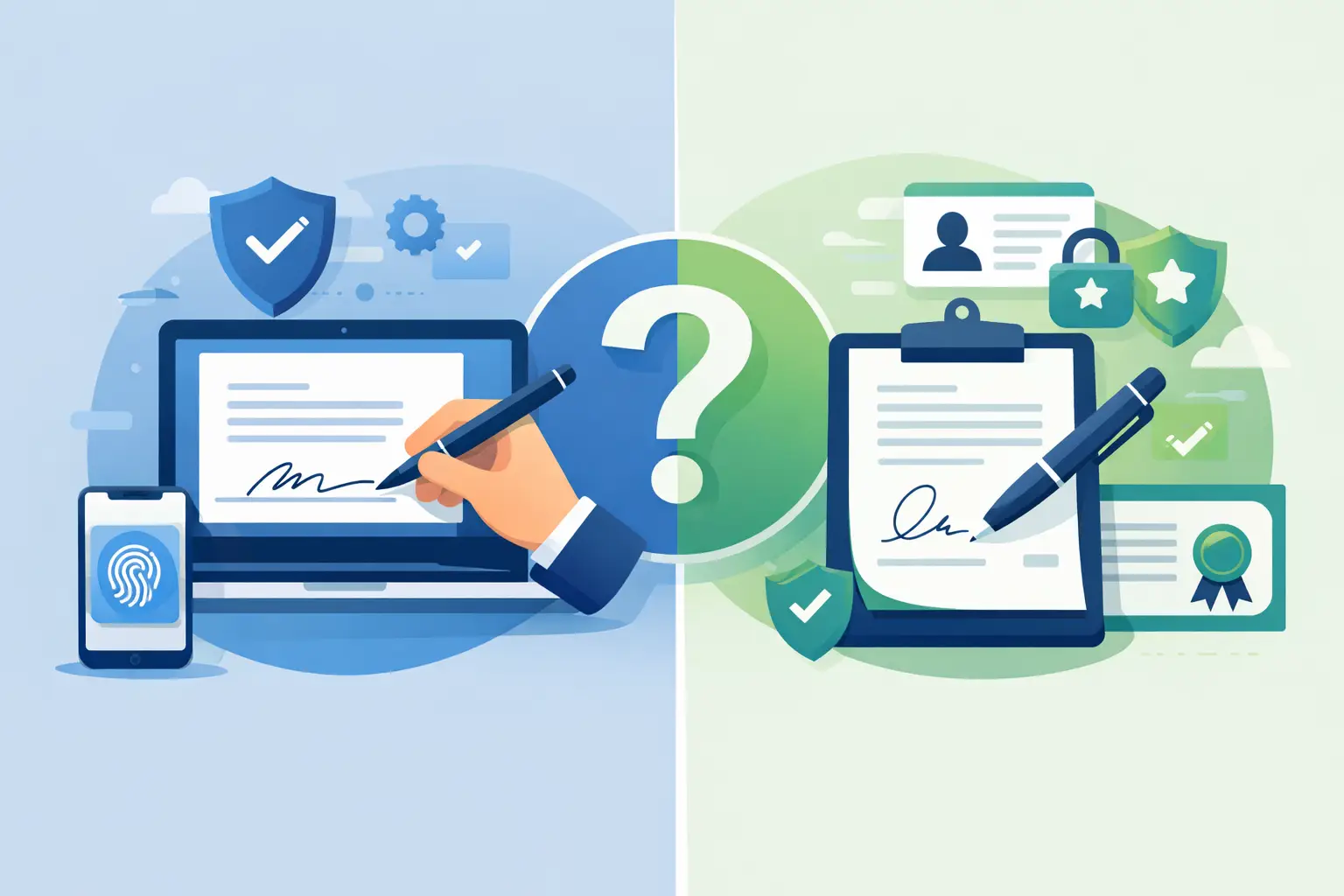
For most business contracts, the right answer is not simply “QES is best”. It depends on the agreement, the parties, the level of risk, and any legal formality that applies in the relevant country. Under eIDAS, both Advanced Electronic Signatures (AES) and Qualified Electronic Signatures (QES) can support legally effective digital agreements across the EU. The difference is how each signature proves identity and protects the signing process.
AES vs QES for contracts: the practical difference
An AES is an electronic signature that meets specific eIDAS requirements. It must be uniquely linked to the signer, capable of identifying them, created using data under the signer’s sole control, and linked to the signed document so that later changes can be detected.
In a well-designed AES workflow, this means more than placing an image of a signature on a PDF. The process creates evidence around the agreement: who was invited, how they accessed it, when they signed, the document version they saw, and whether the document was altered afterwards. An audit trail is central to this evidence.
A QES meets all AES requirements, then adds qualified elements. It is created with a qualified signature creation device and based on a qualified certificate issued by a qualified trust service provider. Before that certificate is issued, the signer’s identity must be verified to the required standard.
The legal distinction is significant. A QES has the equivalent legal effect of a handwritten signature throughout the EU. An AES does not receive that automatic equivalence. However, an AES cannot be denied legal effect or admissibility as evidence merely because it is electronic or not qualified. In practice, an AES can be entirely appropriate for a binding commercial contract, particularly where the evidence package clearly supports the signing process.
Legal validity is not the same as evidential strength
A common mistake is to ask whether AES contracts are “legally valid”. Contract validity usually depends first on the underlying law: offer and acceptance, authority to sign, capacity, consent and any required formalities. Many business agreements do not require a handwritten signature at all.
The signature method matters because it helps prove those points if there is a dispute. A basic click-to-sign flow may show agreement, but it can offer limited assurance about identity. An AES provides stronger technical and procedural evidence. A QES provides the highest standard and benefits from its handwritten-signature equivalence under eIDAS.
That does not mean QES eliminates every dispute. A qualified signature proves a great deal about the signing event, but it cannot fix unclear contract wording, an unauthorised signatory, or a party who was pressured into signing. Conversely, a well-managed AES process can be persuasive evidence where the commercial relationship, email trail and audit record all point to the same conclusion.
For operations, HR and finance teams, the useful question is: if this agreement were questioned in two years’ time, what level of proof would we need, and what would make the process proportionate for the signer?
When AES is usually the sensible choice
AES is often the practical default for recurring, business-to-business contracts where the parties know each other and the risk is manageable. Examples include supplier agreements, service contracts, sales orders, statements of work, confidentiality agreements, routine employment paperwork and client onboarding documents.
It works especially well when speed and repeatability matter. A team may send dozens of agreements each month, use templates with pre-set fields, set signing order, and track outstanding actions from one workspace. Requiring identity verification and qualified certificates for every routine contract can slow that process without delivering a proportionate benefit.
AES is also a strong option when your internal controls already support signer authority. For example, a procurement team may know that contracts below a specified value can be signed by a named department head. The electronic signing workflow then provides a clear record that the authorised person received and signed the final document.
The quality of the workflow matters. Use named signer invitations rather than open links, apply access controls, retain complete audit trails, and ensure that the final signed document is protected against undetected changes. A signature level is not a substitute for sound document management.
When QES is worth the extra step
QES is appropriate where law, counterparty policy or risk appetite calls for the strongest available assurance. It can be particularly useful for high-value agreements, cross-border transactions with unfamiliar parties, documents likely to be contested, and processes where a regulated organisation requires qualified signatures.
Some legal acts have specific form requirements that may require a QES or another prescribed route. Requirements can differ between EU member states and by document type. Real estate transactions, corporate filings, certain consumer arrangements and regulated financial processes are areas where teams should verify the applicable local rules rather than rely on a general rule about e-signatures.
Counterparty expectations also matter. A large enterprise or public body may mandate QES in its procurement process. In that case, using QES is less about debating the legal minimum and more about meeting the agreed process without delay.
There is a trade-off. QES offers stronger assurance, but identity verification and certificate issuance introduce additional steps for the signer. That can be justified for a one-off strategic agreement. It is less attractive when every supplier, candidate or customer must complete the same higher-friction journey for low-risk paperwork.
A straightforward way to choose the right signature
Start with the document, not the technology. Ask whether the agreement has a statutory form requirement, whether a regulator or counterparty specifies QES, and what happens if the signature is disputed. Then consider volume and signer experience.
If the contract is routine, the signers are known, and there is no special legal requirement, AES will often provide the right balance of assurance and efficiency. If the agreement is high-risk, subject to a formal requirement, or involves parties whose identity needs stronger independent verification, QES may be the better route.
It is also sensible to set a written internal policy. For example, your organisation might use AES for standard commercial and HR documents, while reserving QES for agreements above a value threshold, selected regulated workflows, or documents where legal counsel has identified a specific requirement. This prevents teams from making a fresh, inconsistent decision every time a document is sent.
Build evidence into the contract workflow
The strongest signing process begins before the signature request. Confirm that the person signing has authority, send the correct final version, and use clear signatory details. During signing, record the authentication method, timestamps, invitations, reminders and document actions. Afterwards, store the completed agreement and its audit trail together in a controlled location.
For recurring documents, templates reduce avoidable errors. They keep standard terms and signature fields consistent, while signing sequences can ensure the right people approve before an external party is asked to sign. Status tracking helps teams chase incomplete contracts without relying on scattered inboxes.
Asignu supports these practical controls with eIDAS-compliant workflows, structured document management and unlimited AES for teams that need to send contracts regularly without per-signature cost uncertainty. Where QES is needed, it should be an intentional choice for the relevant document rather than a barrier placed in front of every signer.
The decision to make before you send
Treat AES and QES as tools for different levels of assurance, not competing labels. AES is often the efficient choice for everyday contracts when backed by a clear audit trail and sensible internal controls. QES is the right escalation path where the law, the stakes or the counterparty demands it.
Before sending the next agreement, decide what you need to prove: agreement, identity, authority, document integrity, or all four at the highest level. That single decision will make your signing workflow faster, easier to defend and better aligned with the contract in front of you.